.png)
Online vs In-Person Drum Lessons: An NEC Grad's Honest Take
Updated: Sep 21
Most articles about online vs in-person drum lessons are written by people who only do one. Either a Drumeo or Melodics marketer telling you online is just as good as a real teacher, or an old-school in-person teacher saying nothing replaces being in the room. I have a different angle: I run both, and have for five years, with hundreds of students.
Short answer: for 80 percent of students, online lessons are just as effective as in-person, sometimes better. For 20 percent, in-person is meaningfully better. Here's the honest breakdown of which student fits which side, and what to ask before deciding.
What I'm Basing This On
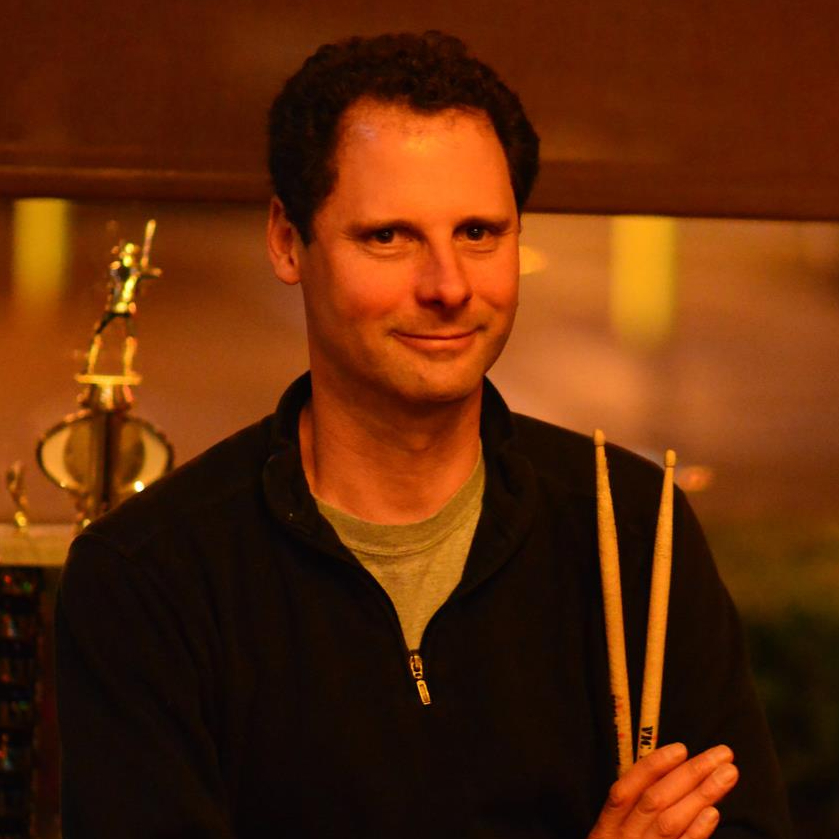
Credentials matter for this answer. I'm a New England Conservatory graduate (Class of 1990, jazz percussion, full scholarship) with over 35 years of teaching experience. My students have gone on to programs at Berklee, the Manhattan School of Music, and the New England Conservatory. I've taught NYSSMA prep students and watched plenty of them earn high scores after only virtual instruction. Same teacher, same conservatory training, both delivery modes. The comparison below is from inside that experience, not from a marketing brochure.
Where Online Wins
The student plays on their own kit. This is the single biggest advantage. In-person students walk into a studio, sit at a kit they don't own, with a setup they didn't choose. The first 10 minutes of the lesson is just adjustment. Online students sit at their own kit, the same one they practiced on all week. No transition time. They sound like themselves immediately.
Zero travel time. A 30-minute online lesson is 30 minutes. A 30-minute in-person lesson, for most families in Westchester County, is 30 minutes of teaching plus 30 to 60 minutes of driving. Over a school year, that's 30 to 50 hours of car time avoided. That's a college course's worth of practice instead.
Practice continuity. After an online lesson, the student is already at the kit, with the new exercise fresh in their head, ready to practice for 15 more minutes. In-person students get home an hour later, do homework, eat dinner, and the lesson is half-forgotten by the time they sit down to practice.
Teachers from anywhere. If you live in rural Westchester, upstate New York, or anywhere without a local drum specialist, online lets you pick the teacher whose style matches your student instead of settling for whoever's nearby. My students join from across the United States and worldwide.
Recording lessons is trivial. Zoom and FaceTime can record. The student can rewatch the explanation later that night. In-person, they'd need to remember from one weekly session. The replay advantage compounds fast.
Where In-Person Wins
Hands-on hand-position correction. For new students under age 8 or any beginner with a habit-forming grip problem, sometimes a teacher needs to physically adjust the stick in their hand. Over video I can verbally walk them through it 95 percent of the time. The remaining 5 percent is faster in person.
Acoustic kit at full volume. In a studio you can play loud. At home, kids often have to play softer or use mesh heads to keep peace with neighbors. For advanced students working on stage dynamics, in-person studio time is hard to replicate.
Very young kids (under 7). Attention spans under age 7 are short enough that a physical adult next to the kit helps keep focus. Online works for ages 5 and 6, but it requires a parent next to the student. In-person doesn't.
Ensemble play. Eventually a drummer needs to play with other live musicians in the same room. That can't be replicated online for technical latency reasons. Most students don't need this in their first one to two years, but advanced students do.
The Camera Setup Question (Where Most Online Lessons Fail)
Bad camera angle is the single most common reason online lessons disappoint families. The teacher needs to see three things: the student's hands and sticks, the drum surface or pad, and ideally the student's face for engagement. Most students set their laptop on a music stand facing them and the teacher can only see their face. That doesn't work.
The fix takes 10 minutes the first lesson. Phone or tablet propped at a 45-degree angle behind the student looking over their shoulder at the kit. If a second device is available, that one shows the face. Both join the same Zoom call. Cost: zero. Difficulty: trivial. Most parents have a spare phone or iPad lying around.
Once that setup is in place, the online lesson loses 90 percent of its visual disadvantage. The remaining 10 percent gets covered by good verbal instruction. After 12 weeks, neither teacher nor student notices a difference.
What Doesn't Actually Matter
Internet speed. Almost any home connection above 10 Mbps works. The audio matters more than video quality.
Headphones vs speakers on the student side. Both work. Headphones reduce some bleed from the kit into the mic but it's marginal.
Whether the kit is acoustic, electronic, or mesh-head. Doesn't change the lesson quality online. The teacher's job is the same regardless of what the student is hitting.
Whether the student is in Westchester or 3,000 miles away. Zero difference once the camera is set up.
Should You Pick Hybrid?
Hybrid is the right answer for many families. Start in person for the first 6 to 12 weeks while the fundamentals get set, then move to mostly virtual once the student is confident. Some families come in for one in-person session per month and do the other three online. The trade-off between travel time and full hands-on time becomes a clear choice once the student has the basics down.
What to Ask Before Picking
Three questions answer this honestly for most families:
1. How old is the student? Under 7, lean in-person. 7 and up, online works fine.
2. How far is the studio? Over 20 minutes one way each lesson, the travel cost makes online clearly better unless there's a specific reason for in-person.
3. Are you preparing for a specific outcome (NYSSMA, audition, band)? For NYSSMA prep and audition prep, both modes work equally well. For a kid who just wants to bash and have fun, in-person is more playful and probably worth it if it's convenient.
Try a Free First Lesson
The first lesson is free, on Zoom, FaceTime, or in person at Rudy's studio in Ardsley, NY. Book your free first lesson at rudyfeinauer.com/schedule-lesson.
Related reading
More parent guides from Rudy:


